The Work Ontology
A living map of how your enterprise actually runs. Every actor, activity, and artifact of work. Every handoff between them, in one continuously updating representation.
Request a DemoA graph representing how work actually happens
Fluency connects the work being done, the people and agents who do it, and what they produce into one model. These three layers give you end-to-end visibility into how work really runs.
Because the model mirrors reality, it's the ground truth your AI strategy will run on.
Activity
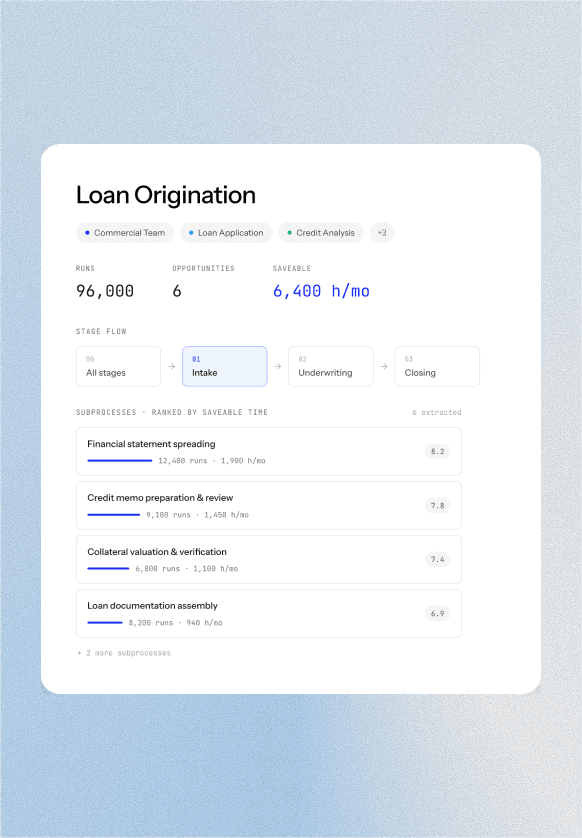
What the work is. A reconciliation task, an onboarding process, a deep work session. Every unit of work, captured as it happens.
Actor
Who is doing it, resolved to one identity across every system. The same person in email, in Slack, and in the CRM is understood as one actor.
Artifact
What the work produces or consumes. An invoice, a contract, a case record, tracked as it moves across screens, tools, and teams.
It infers why, not just what
The ontology does not log what someone clicked. It infers why they were doing it, where processes are repetitive and where they break down.
That correlation to business outcomes is what separates a work ontology from process or task mining. It is what makes discovery useful at enterprise scale, rather than just producing a disconnected observation with no clear pathway towards automation.
The loop that compounds
Everything Fluency does reads from the ontology and feeds back into it, so the map gets richer with every cycle and everything built on it gets better.
Observe
Work is captured at the point of execution and understood by intent towards business outcomes.
Understand
Patterns resolve into processes, and the ontology surfaces the golden path for each.
Automate
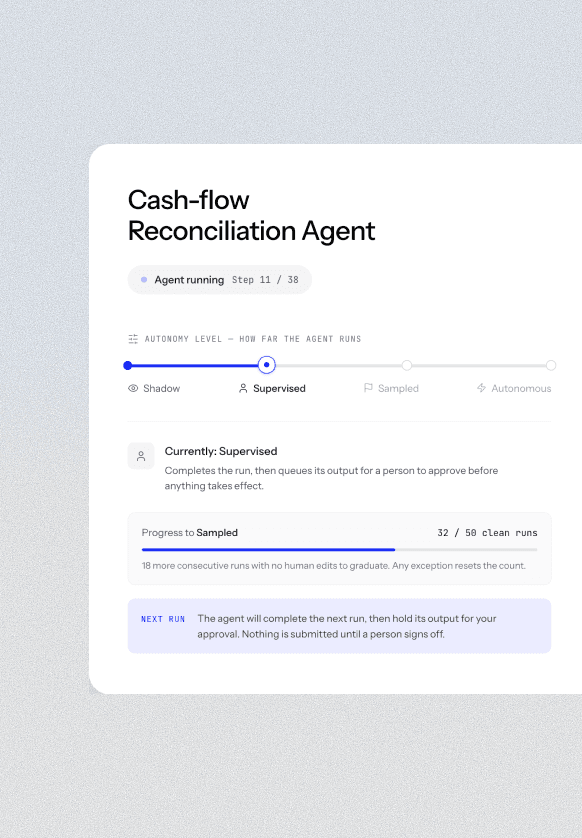
Agents are deployed from the ontology and work along the golden path.
Observe
The agent’s work is seen like any other work and feeds straight back into the ontology.
Automation that adapts instead of breaking
Because the ontology updates continuously, the agents built on it are not frozen to a hardcoded workflow. At the moment an agent needs to make a decision, it traverses the live ontology and works from what is true right now.
When a product changes, a field moves, or a person leaves, the agent adapts with the business rather than shattering the way brittle RPA does. Fluency builds and maintains these automations, so the system improves over time instead of becoming obsolete.
The memory that outlives the people
Tacit knowledge and the hidden steps that make work function usually leave when the people who hold them do. In the ontology, they are captured as the work happens.
The graph becomes the company’s memory of how it operates. It stays complete as teams change and as new work enters and old work retires.
The more of your work the ontology holds, the sharper every decision built on it becomes. Process mining and RPA are only as current as the day they shipped. A work ontology keeps learning as the work changes.
Every feature of Fluency is built on the ontology