
Donald La
The Difference Between Process Mining and Adaptive Work Intelligence
Process mining shows you what happened in your systems. Adaptive work intelligence shows you why work happened the way it did, and helps you transform it. Understand the critical differences and why work intelligence is the natural evolution enterprises actually need.

What Process Mining Promised vs. What It Delivered
Process mining emerged with a compelling promise: make the invisible visible. Show enterprises how their processes actually work, not how they think they work.
For over a decade, companies like Celonis, UiPath, and others built an industry around extracting event logs from enterprise systems and reconstructing process flows. The value proposition was clear: see bottlenecks, identify inefficiencies, optimize workflows.
And for a specific type of visibility, process mining delivered.
If you needed to understand how invoices moved through your ERP, how orders flowed through your procurement system, or how cases progressed through your CRM, process mining could show you. System-to-system transactions, timestamps, handoffs between applications. The digital exhaust of structured workflows.
But enterprises discovered a fundamental limitation: process mining only sees what happens inside systems. It doesn't see the work that happens between them.
And more critically, it doesn't help you do anything about what it reveals.
What Process Mining Actually Sees
Process mining tools analyze event logs from enterprise systems. They reconstruct process flows by connecting timestamped events: invoice created in SAP, approval requested in workflow tool, payment processed in treasury system.
This approach works when work happens inside a single system or tightly integrated systems, every action generates a logged event, and the process is highly structured and system-driven.
Process mining excels at questions like: How long does an invoice sit in the approval queue? Where do purchase orders get stuck? Which system transitions take the longest?
These are valuable questions. But they're not the questions that explain why performance varies 6x between employees doing the same work. And they don't give you the data you need to actually fix the problem.
The Three Critical Gaps
Process mining has three fundamental limitations that prevent it from delivering operational transformation.
Gap 1: It only sees what systems log
Most work doesn't happen in logged system events. It happens in Slack messages coordinating with suppliers. In emails clarifying requirements. In Excel spreadsheets reconciling data before entering it into the ERP. In phone calls resolving exceptions.
An invoice might show a 10-day cycle time in your process mining dashboard. But the tool can't tell you that 7 of those days were spent in email back-and-forth because the OCR failed and someone had to manually verify the data. That work is invisible to process mining.
Gap 2: It requires extensive integrations
Process mining tools need API access to your systems' event logs. For each system you want visibility into, you need API integration (if one exists), data extraction and transformation, event log standardization, and ongoing maintenance as systems change.
Enterprises with 4,000 applications don't have time to integrate them all. So they pick a few critical systems and accept that most work stays invisible. The $11 billion manufacturer we worked with spent 12 weeks just counting their applications. Integrating them all for process mining would have taken years.
Gap 3: It shows what happened, not why, and doesn't help you act
Process mining can tell you an invoice took 28 days to process. It can't tell you why one regional office processes the same invoice in 8 days. It can show you variance exists. It can't show you which specific workflows to standardize, which applications to decommission, or which processes to automate first.
You get dashboards showing problems. But no path to solving them.
The "why" is where the optimization opportunity lives. And the "what to do about it" is where transformation actually happens. Process mining delivers neither.
What Adaptive Work Intelligence Actually Does
Adaptive work intelligence solves a fundamentally different problem. It doesn't just track what happened in your systems. It captures how work actually gets done across all your tools, by all your people, in real-time. And then it helps you transform it.
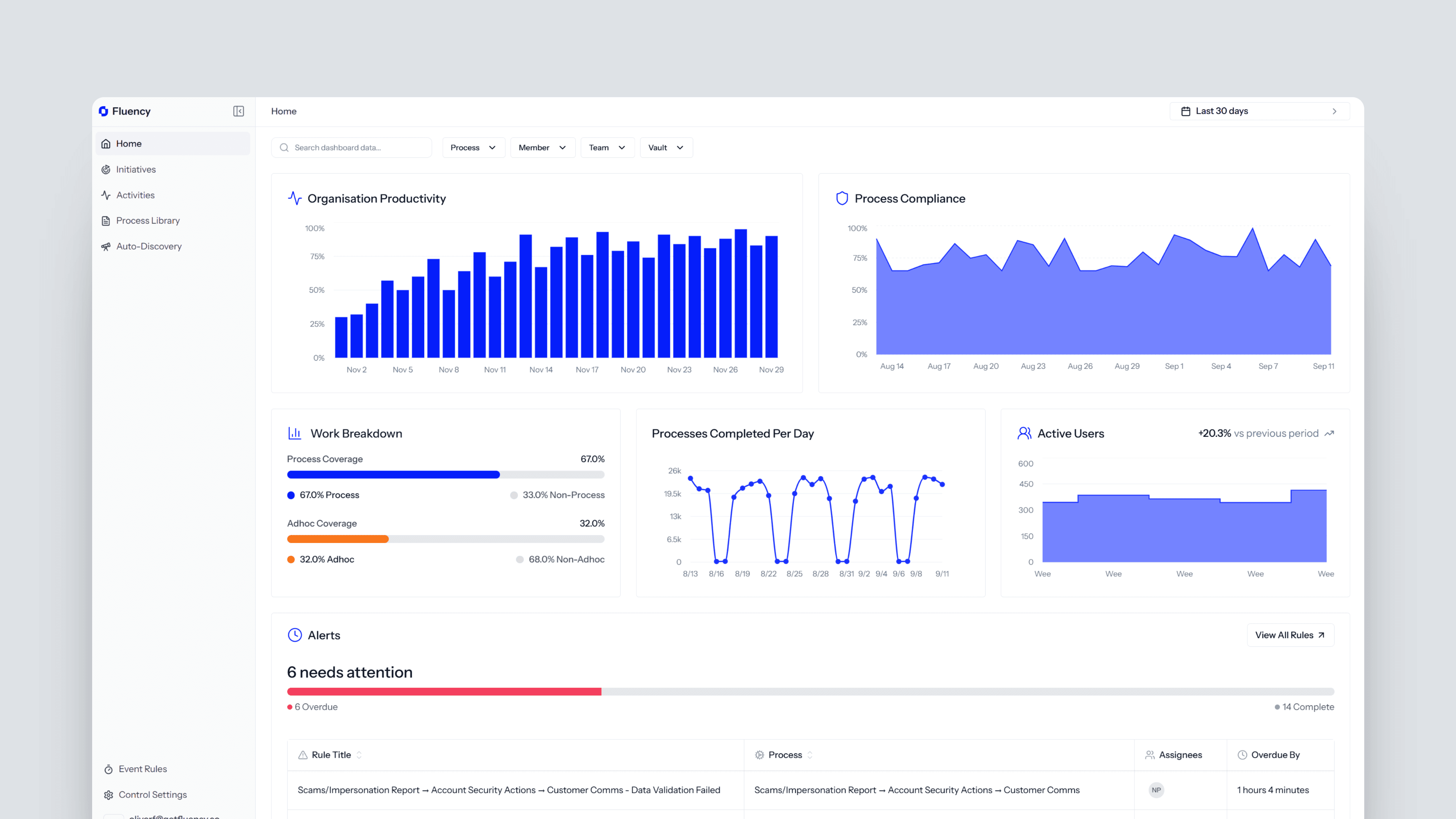
Fluency sees work the way it actually happens: across email, Slack, Excel, your ERP, your CRM, your claims portal, your telephony system, and dozens of other tools simultaneously. No integrations required. Deployed in an hour, not months.
But the critical difference isn't just better visibility. It's actionable intelligence.
Process mining asks: "What path did this transaction take through our systems?"
Work intelligence asks: "How did this person actually do this work, why does their method differ from someone else doing the same work, and what should we do about it?"
The Invoice Processing Example
An $11 billion manufacturer had 47 different ways of processing invoices across their organization. Process mining could show them that some invoices moved through SAP quickly while others didn't. But it couldn't explain why. And it certainly couldn't tell them which workflows to keep and which to eliminate.
Fluency showed them:
- Finance had invented 47 workflow variants
- 3 were fast and efficient (8 steps, leveraging portal shortcuts, early validation)
- 44 were slow and wasteful (23+ steps, manual data entry, late-stage error discovery)
- The efficient workflows existed in specific regional offices and stayed invisible to everyone else
Process mining saw system transactions. Fluency saw human execution patterns.
But here's where work intelligence becomes transformation, not just visibility.
What Fluency enabled them to do:
Standardize the 3 efficient workflows automatically. Fluency didn't just identify them. It captured exactly how they worked. Which systems were used in which sequence. How long each step took. Where handoffs occurred. What made them faster than alternatives. This became the new standard, pushed out to the entire organization.
Identify which of 4,000 applications actually mattered. Fluency showed them which applications supported the efficient workflows and which didn't. 15 applications were used by fewer than 5% of the finance team. Those got decommissioned. Millions in licensing costs eliminated. Not based on usage reports or stakeholder opinions. Based on which systems actually enabled effective work.
Prioritize automation roadmap. They now had all process data mapped and ready for AI agents and RPA. But more importantly, they knew which processes to automate first. The 3 efficient workflows that were proven to work. Not the theoretical 15-step process documented in Confluence. Not a random selection from 47 variants hoping one worked.
Build the CFO business case with real productivity data. Not consultant recommendations. Not theoretical process maps. Real data showing the delta between efficient and inefficient workflows, measured from a user-centric perspective. Which systems to decommission. Which workflows to standardize. Which regional best practices to replicate company-wide. Exactly where the $10 million in savings would come from.
The result: $10 million in application cost savings identified, 47 workflow variants discovered, 3 efficient paths standardized, 44 wasteful variants eliminated. Process mapped and ready for automation.
Process mining would have shown variance in processing times across a few integrated systems. Work intelligence showed how work happened across all 4,000 applications and gave them the data to transform it.
Why Process Mining Can't Evolve to Close This Gap
Process mining is fundamentally constrained by its architecture. It relies on structured event logs from enterprise systems. That's its strength for system-level analysis. But it's also its limitation.
To see cross-application work and enable transformation, process mining would need to integrate with every tool (impossible at enterprise scale), capture unstructured work (email, Slack, spreadsheets), understand context and intent (not just timestamps and events), and work without APIs or event logs.
This isn't an incremental improvement. It's a different technical approach.
Process mining tools are too rigid to evolve into work intelligence platforms. They were architected for a specific problem (system transaction analysis) and optimized for that use case. Extending them to capture real work execution and enable transformation would require rebuilding from scratch.
That's why adaptive work intelligence exists as a distinct category. It's not process mining 2.0. It's the natural evolution of what process mining attempted to achieve but couldn't deliver because of its architectural constraints.
From Visibility to Transformation
The fundamental difference between process mining and work intelligence isn't just what each can see. It's what each enables you to do.
Process mining gives you dashboards. Reports showing system-level variance and transaction flows. You know problems exist. You still need consultants to tell you what to do about them. You still need months of workshops to build transformation roadmaps. You still need to guess which processes to standardize and which to automate.
Work intelligence gives you transformation capabilities. Not just "here's the problem." But "here's exactly what to do about it, here's which workflows to standardize, here's which applications to cut, here's which processes to automate first, and here's the data to prove it will work."
Fluency doesn't just surface the 47 invoice workflow variants. It identifies the 3 that work, captures exactly how they work, standardizes them across the organization, shows which applications support them and which don't, and maps the process for automation. All automatically. All in weeks, not quarters.
That's the difference between operational visibility and operational transformation.
The Technical Differences That Actually Matter
Deployment:
- Process mining: Months of integration work, API connections, data pipelines, ongoing maintenance
- Work intelligence: One hour deployment, no integrations, works across all tools automatically
Data source:
- Process mining: System event logs (structured, limited to what systems track)
- Work intelligence: Actual work execution (unstructured, captures everything people do)
Visibility:
- Process mining: What happened in systems, when it happened, which system transactions occurred
- Work intelligence: How work was done, who did it, which steps they took, why methods differ
Transformation capability:
- Process mining: Identifies that variance exists, requires consultants to interpret and recommend actions
- Work intelligence: Captures best practices, enables standardization, prioritizes automation, decommissions unused systems, all automatically
Outcome:
- Process mining: Reports and dashboards
- Work intelligence: Transformed operations
Why Work Intelligence Is the Natural Evolution
Process mining represented an important step in enterprise visibility. It proved that operational data could reveal hidden inefficiencies and drive transformation.
But process mining was constrained by its dependence on system logs and structured events. It could only see part of the picture. The part that systems tracked. And it couldn't help enterprises act on what it revealed.
Adaptive work intelligence is what process mining always aspired to be: complete visibility into how work actually happens, plus the transformation capabilities to do something about it. Not just in systems, but across all the tools, communications, and human interactions that make up modern enterprise operations.
The original goal of process mining, to make the invisible visible and enable data-driven optimization, required more than system event analysis. It required seeing the work itself. And it required giving enterprises the data and tools to transform that work, not just report on it.
That's what work intelligence delivers. It's not an incremental improvement on process mining. It's the realization of the original vision, achieved through a fundamentally different technical approach that captures work execution and enables transformation.
Process mining gave enterprises visibility into their systems. Work intelligence gives enterprises the capability to transform their operations.
Most enterprises pursuing transformation need the latter. They need to see how work actually happens and know exactly what to do about it.
That's why adaptive work intelligence represents the next natural step in operational visibility. Process mining opened the door. Work intelligence walks through it and delivers what enterprises actually need: complete execution visibility that enables real transformation.
Ready to see how work actually happens in your organization?
Fluency delivers complete workflow visibility and transformation capability in weeks, not months. No integrations, no system dependencies, no limitations.
See what process mining can't show you. And do what it can't help you do.