
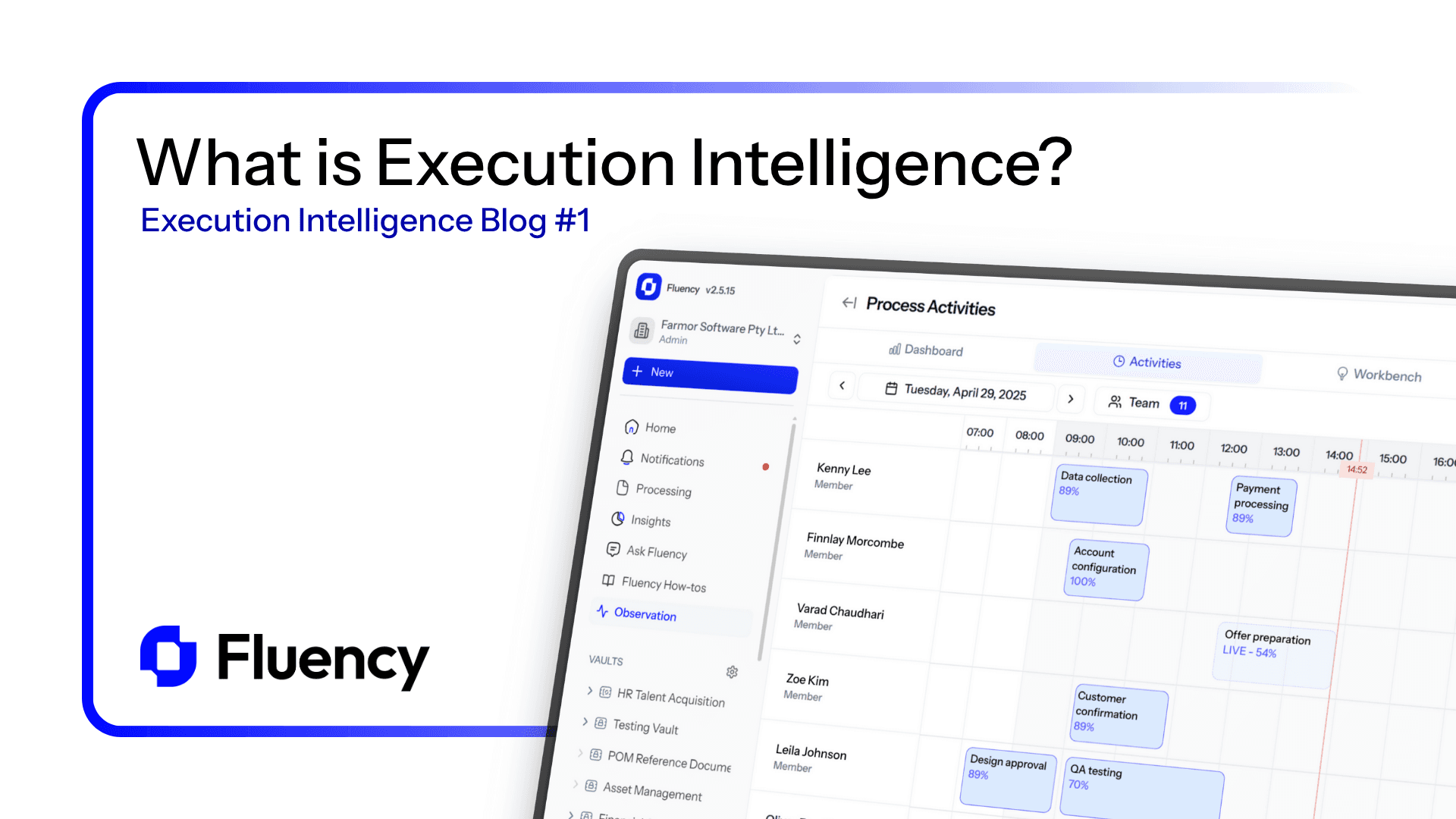
Execution intelligence is real-time visibility into how work is actually executed — across every tool, team and system — rather than how it is documented, planned or reported after the fact.
That is the short answer. The longer answer is why anyone needed a term for it, and what the category ended up being called.
The Problem the Term Was Coined For
Most enterprise teams operate blind. Work breaks down silently. Customers complain before anyone notices. Audit flags arrive as surprises. And when leaders ask "how did this happen?", nobody has a clear answer.
Technology was supposed to fix this. Dashboards. SOPs. Process tools. But these systems show the map, not the territory. They describe what should happen, not what is happening.
Leaders assign targets at the start of the quarter and review results at the end. By then it is too late to do anything but reconstruct the story.
That is the visibility gap. Execution intelligence was the name given to closing it.
Why the Existing Tools Do Not Close It
Each category of tool sees a slice, and each slice excludes the part that matters most.
Dashboards report outcomes. They tell you the close took nine days. They cannot tell you that four of those days were a file sitting in an inbox.
Process mining reads system logs, so it only sees work that a system of record captured. The spreadsheet reconciliation, the Slack thread where the exception got resolved, the email chain that unblocked the approval — none of it is logged, so none of it exists.
SOPs and process documentation describe the intended path. Real execution diverges from that path constantly, and the divergence is usually where the cost is.
Consultants and surveys capture recollection. People underestimate the repetitive work and forget the small inefficiencies that compound daily.
Meanwhile your best people leave and take undocumented knowledge with them.
What the Category Is Called Now
"Execution intelligence" described a real gap, and several vendors reached for adjacent names at the same time: execution intelligence, operational intelligence, adaptive work intelligence. The category has since settled on work intelligence, and that is the term we use.
The substance did not change. The naming did, and it is worth being direct about that rather than leaving a reader to reconcile four labels for the same idea.
Underneath it sits one artifact: the work ontology, a living map of how an enterprise actually runs — the actors, the activities and the artifacts, and how they connect in practice rather than on paper.
Where Fluency Fits
Fluency is a work intelligence platform that shows large enterprises where AI will have the biggest impact by finding the best work to automate first. It observes work at the point of execution, deploys AI agents, and measures results against an observed baseline.
Concretely, that means three things:
Observation without integration. Fluency builds the work ontology by observing work as it happens, not by wiring into every system first. No integration project has to succeed before you learn anything.
Opportunities ranked by return. Every candidate workflow carries projected hours and cost, so the question "where should we deploy AI?" has a ranked answer instead of a workshop.
A baseline that outlives the pilot. The same observation that found the opportunity measures whether the deployment moved it — against how the work actually ran before, not against an adoption dashboard.
At one education software company, that produced 25 mapped workflows and 48 ranked automation opportunities worth more than 24,800 hours a year. The largest one was client data being copied by hand between the CRM and internal finance tools. It had never appeared on anyone's list.
The Bottom Line
Execution intelligence named a real problem: you cannot manage what you cannot see, and almost nothing in the enterprise stack shows you how work is actually executed.
The name for the answer settled on work intelligence. The requirement did not move.
If you can see how work runs, deciding where to put AI is straightforward.
If you cannot, every AI investment is a guess — and the ones that fail look exactly like the ones that worked until someone asks for the number.