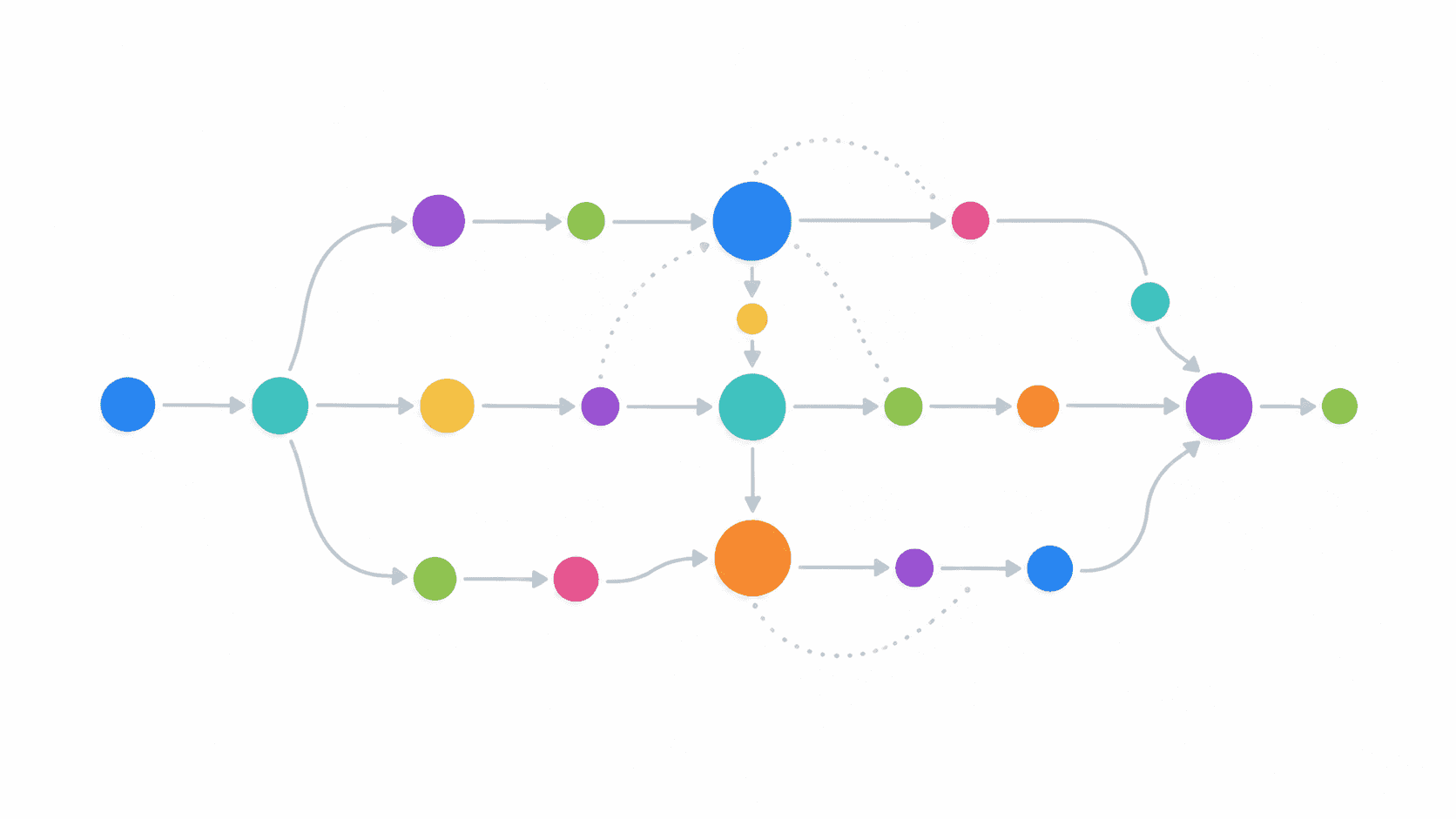

Enterprises built systems to track customers, money, and products. But the work itself was never recorded. When an operational bottleneck forms or a transformation initiative stalls, operations leaders fall back on outdated process maps, manual interviews, and rough estimates of what actually happens across their teams. Work intelligence gives them a more accurate picture by observing how work actually happens across the enterprise.
This article explains work intelligence and how it differs from process mining and task mining. It also covers Fluency's action layer and what we're building toward: the ability to simulate changes across an enterprise before making them.
TL;DR
-
Work intelligence continuously observes enterprise workflows to identify automation opportunities, deploy AI agents, and measure results.
-
Process mining reads system event logs, task mining records desktop activity during defined studies, and work intelligence observes workflows continuously across applications.
-
The action layer builds and deploys automations, then measures their performance against an observed baseline.
-
Each approach has a home. Process mining suits workflows recorded in connected systems, task mining suits focused studies of individual teams, and work intelligence suits enterprise automation programs that need deployment and measurable results.
What work intelligence is
Work intelligence is an approach to understanding how work happens across an enterprise, identifying high-value AI automation opportunities, and measuring the results of deployed automations.
Fluency is a work intelligence platform that shows large enterprises where AI will have the biggest impact by finding the best work to automate first. It observes work at the point of execution, deploys AI agents, and measures results against an observed baseline.
Fluency follows three steps: observing how work happens, identifying and deploying automation opportunities, and measuring the results.
-
Step 1: See the work. A desktop agent captures work across systems, teams, and apps without needing direct system access. It deploys in under an hour without requiring people to change how they work or fill in forms. First insights arrive within hours.
-
Step 2: Find and deploy the opportunities. As the agent observes work, Fluency builds a work ontology that maps how tasks and workflows connect across the enterprise. It ranks candidates by ROI and classifies each as either programmatic automation or an AI agent. Then it builds and maintains the automations.
-
Step 3: Prove the results. Fluency measures throughput, completeness, quality, and rework against the recorded pre-deployment baseline to show the impact of each automation and calculate its ROI.
Fluency observes work, not workers. Its desktop agent captures workflow activity without recording keystrokes or screens, and the data isn't attributed to individual employees. Fluency is SOC 2 compliant.
Process mining vs task mining vs work intelligence
Process mining, task mining, and work intelligence all use different methods to capture and analyze enterprise workflows. The differences come down to where each method collects data, how much activity it can observe, and what happens after discovery. Our guide to process mining vs work intelligence explains these differences in more detail.
Process mining reads structured event logs from enterprise applications like SAP or Oracle. It's best for analyzing repeatable processes, such as invoicing, that are recorded in those systems. It reconstructs workflows from recorded transactions, but manual work completed outside connected systems may be absent from the process model.
Task mining records desktop interactions over a defined recording period using methods such as screenshots and action logs. It's useful for finding repetitive tasks and automation opportunities within a specific team, but it misses work performed outside the recording period or by teams that aren't included in the study.
Work intelligence continuously observes workflows across applications such as spreadsheets, email, web browsers, and enterprise software. It tracks manual work between applications and captures workflow changes and exceptions as they occur, including activity missing from system logs or short-term recordings. Work intelligence fits enterprises that need to identify and prioritize automation opportunities across systems and teams.
The table below compares the three by data source, how current the information is, and what happens after discovery.
| Process mining | Task mining | Work intelligence | |
|---|---|---|---|
| Data source | Structured system event logs and database entries | Desktop recordings and interaction logs | Continuous observation of application states and user interfaces via the operating system |
| How current it is | Depends on source data and refresh schedules; some platforms support continuous monitoring | Snapshot limited to the recording window | Always on and continuously updated in real time |
| What happens after discovery | Can trigger or orchestrate automations, depending on the platform and connected systems | Identifies automation candidates and supports further analysis or automation development | Builds and maintains automations, deploys AI agents, and measures results against an observed baseline |
When each approach fits
Process mining works well when workflows run inside connected enterprise systems and the organization has the data engineering resources to model the event logs. Compare the best process mining tools and Celonis competitors and alternatives.
Task mining is good for studying manual tasks within a specific team over a defined period.
Work intelligence is best for enterprises that need to identify and prioritize automation opportunities, deploy automations, and measure their results. For more detail, see Fluency vs Celonis and our guide on how to identify and rank automation opportunities.
From the control layer to the action layer
Enterprise AI investments are under pressure to deliver measurable returns, and the research shows most organizations are struggling to prove it.
-
Only 25% of AI initiatives have delivered expected ROI, and only 16% have scaled enterprise-wide (IBM 2025 CEO Study).
-
37% of respondents attribute an impact on earnings before interest and taxes (EBIT) to AI (McKinsey, The State of AI).
-
Gartner predicts that over 40% of agentic AI projects will be canceled by the end of 2027 because of escalating costs, unclear business value, or inadequate risk controls (Gartner).
Enterprises are deploying AI agents faster than they can demonstrate a return. Without clear evidence of business value and adequate controls to manage risk, many of those projects will fall short. The control layer provides visibility into operations: observing how work happens and finding opportunities for automation. The action layer takes the next step by deploying automations into workflows and measuring their results against a baseline.
Fluency handles both. It records workflow performance before deployment and compares it with the results afterward to measure ROI across systems. That gives operations leaders the evidence to prove the value of an automation and decide whether to extend it to other workflows.
For example, in one financial services back-office team, Fluency mapped hundreds of manual processes and surfaced a tax workflow that took up to 15,000 hours a month in repetitive processing and data entry. Through its Automations feature, Fluency deployed an AI agent that executes the workflow from start to finish, with a human reviewer providing final sign-off.
What we're building toward: simulating change before making it
At Fluency, we're building toward the ability to simulate changes across an enterprise before implementing them. Operations leaders would be able to estimate the ROI of a proposed change and see how it would affect other workflows before making a decision.
Leaders could model the effects of deploying an AI agent, shifting team capacity, or changing workflow handoffs. They could identify potential bottlenecks, assess operational risks, and estimate financial returns before committing resources or disrupting existing operations.
Gartner calls this concept a digital twin of an organization: a software model that uses operational data to represent how an organization works and simulate the effects of proposed changes.
See how work moves in your operation
Understanding how work moves across an enterprise shows operations leaders where automation will have the greatest impact, and whether it delivered the expected results.
Stop guessing how work happens and start measuring exactly how it flows. Request a Fluency demo to see the action layer in your own environment.
Work intelligence FAQs
What is work intelligence?
Work intelligence is a category of software for identifying automation opportunities from observed enterprise workflows. Fluency uses this approach to show large enterprises where AI will have the biggest impact by finding the best work to automate first, deploying AI agents, and measuring results against an observed baseline. It captures work continuously at the point of execution across apps and teams without needing backend event logs or direct system integrations.
How is work intelligence different from process mining?
Process mining relies on backend system event logs, while work intelligence observes work directly across desktop applications without needing system logs. Process mining analyzes events recorded in connected systems, so manual work outside those records may be missing. Work intelligence continuously captures the execution of work across spreadsheets, browsers, and documents in real time.
How is work intelligence different from task mining?
Task mining records desktop activity during a defined study, while work intelligence continuously observes workflows across applications. Task mining's findings are limited to the people, activities, and recording period included in the study. Work intelligence runs continuously at enterprise scale, building a semantic understanding of workflows without recording screens or keystrokes.
What is the action layer?
The action layer is Fluency's execution capability within its work intelligence platform, turning workflow visibility into deployed automations and measurable ROI. Fluency builds and maintains automations, deploys AI agents directly inside workflows, and measures business performance against an observed pre-deployment baseline.
Is Fluency employee monitoring software?
No. Fluency observes work, not workers. The platform captures no keystrokes, doesn't record screens, and never attributes data to individual employees. Privacy is built into the architecture to focus on workflows rather than individual performance. For more detail on SOC 2 compliance and data architecture, see our FAQ and security documentation.